EO/IR perception for maritime & defense.
Object detection at sea has to survive glare, spray, horizon ambiguity and tiny far-field targets, without labeling artifacts as objects.
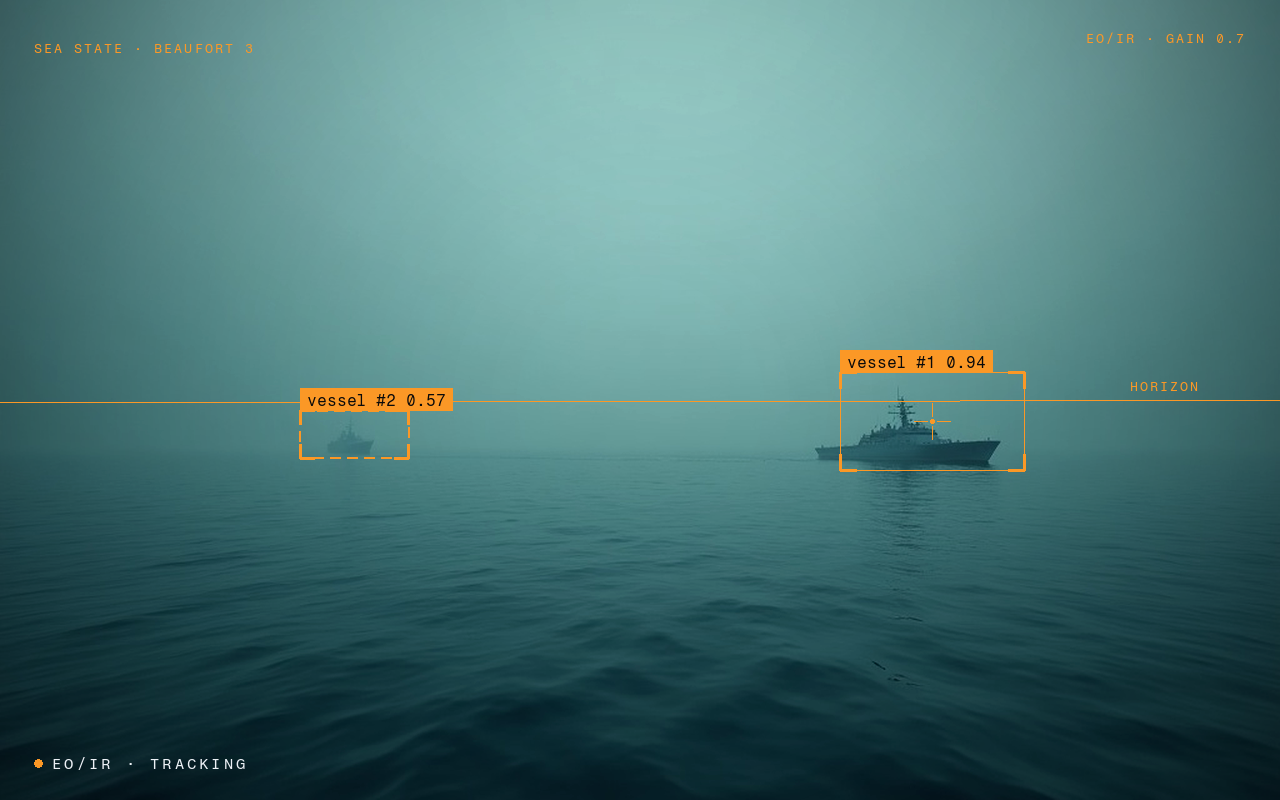 EO/IR · glare · far-field
The problem
At sea, the hardest objects are the smallest ones.
EO/IR perception must detect vessels, navigation aids and hazards where glare, spray and horizon ambiguity make labeling error-prone.
Far-field targets can be a handful of pixels, and spray, glare and wakes must never be mislabeled as objects.
How io-ai helps.
Trained experts, an SOP-driven QA pipeline, and rejection-reason metadata on every task, held to over 98% accuracy.

EO/IR object detection
Vessels, buoys, aids-to-navigation and structures.
Track IDs & oriented boxes
Consistent identity and orientation across frames.
Scene metadata
Horizon line, sea state (Beaufort 0–9), visibility, time-of-day.
Ignore-region discipline
Spray and glare flagged, never labeled as targets.
Modalities & techniques
EO/IR sensor
image
video
oriented bbox
track ID
Proven work.
A real maritime & defense engagement, with a hard number.
Maritime & Defense · EO/IR
EO/IR
detection with sea-state & visibility metadata in degraded conditions
Maritime EO/IR object detection for autonomous vessels.
Uber AI · Regent
Read the case study

Let's talk
Tell us what you're building.
Send us your data challenge and we'll scope a pilot, usually within a couple of working days.